
 By
By There is a quiet reordering happening inside Ghana’s insurance market. It is not being debated publicly. It is not being legislated in Parliament. It is not being announced as a reform. But it is happening. And like many structural shifts, it is easiest to see not in speeches, but in documents.
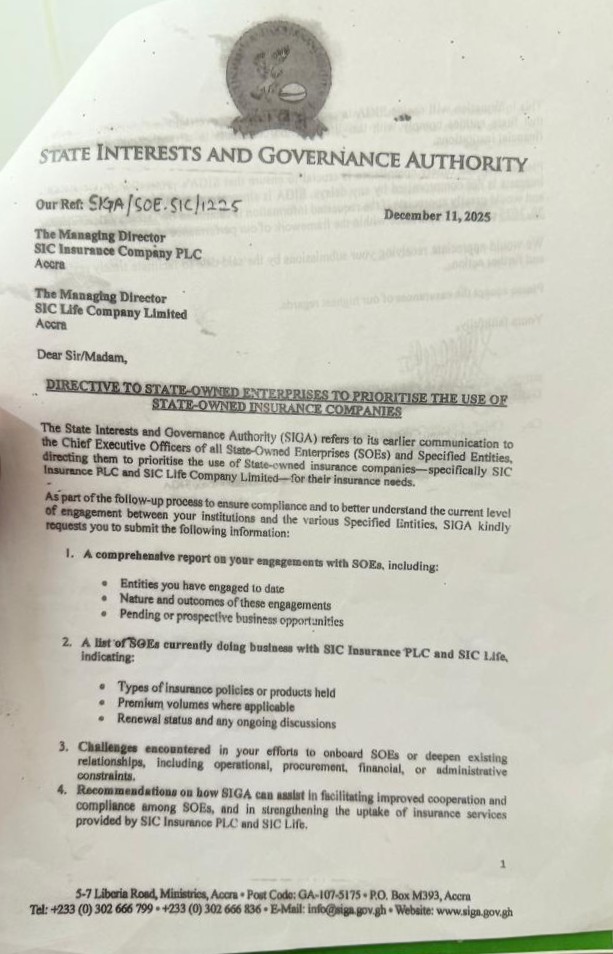
On 11th December 2025, the State Interests and Governance Authority (SIGA), issued a communication to state insurers and followed up with engagement expectations across State-Owned Enterprises and specified entities. The message was clear in effect, even if carefully worded in tone.
State institutions were to prioritise insurance placements with state-linked insurers, specifically SIC Insurance PLC and SIC Life Insurance Ltd.
Within weeks, that signal began to move through the system. Letters followed. Engagements followed. And more importantly, behaviour began to change. A letter from SIC Life Insurance Ltd, dated 23rd December 2025 and addressed to GIHOC Distilleries, does not operate in isolation. It explicitly references guidance from the Ministry of Finance and SIGA, and requests to be “favourably considered” in the institution’s renewal cycle. It is framed as a commercial request, but anchored in policy alignment.
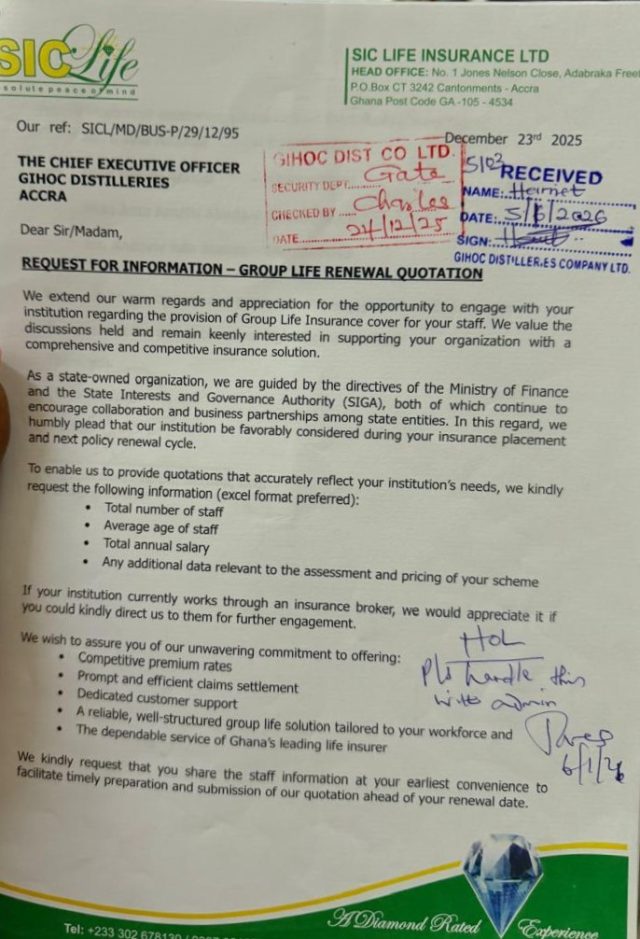
That distinction matters. Because in a purely competitive market, no insurer needs policy backing to compete. It competes on price, underwriting strength, claims record, and reinsurance capacity. But when policy begins to travel with the proposal, the playing field changes.
Now consider the scale of what is being influenced. SIGA’s own portfolio, as of its most recent reporting cycle, covers over 140 active entities, including 53 State-Owned Enterprises, 31 Joint Venture Companies, and multiple state-linked institutions across energy, finance, transport, and infrastructure. These are not minor clients. They include the Ghana National Gas Company, Volta River Authority, Ghana Revenue Authority, and Cocoa Marketing Company. Each of these institutions carries complex, high-value risk portfolios that run into hundreds of millions, and in some cases billions, of cedis in insured exposure.
Insurance at this level is not retail. It is structured finance. It determines which insurer leads, which local insurers participate, which international reinsurers commit capacity, and how risk is priced in global markets. So when placement patterns begin to shift, the implications are systemic.
Now look at the market structure itself. In Ghana’s non-life insurance segment, no single firm dominates absolutely, but the top tier is well defined. Enterprise Insurance leads with roughly 30 percent market share, while Star Assurance, SIC Insurance PLC, Hollard, and GLICO General each operate within the 4 to 6 percent range. The remaining market is fragmented across smaller players. This is not a monopoly market. It is a competitive concentration.
And in that system, SIC Insurance PLC is not the dominant private competitor. It is one of several mid-tier players competing for market share. Even more importantly, SIC is not a typical state agency. SIC Insurance PLC is a publicly listed company. Government holds a minority stake, approximately one-third, while the majority of shareholders are private and institutional investors. So when state institutions are guided toward SIC, they are not transacting internally within government. They are directing public business toward a commercial entity with mixed ownership.
That is where the structure becomes more complex. Because the same state that oversees SOEs through SIGA, influences procurement direction through policy, and regulates the insurance market through the National Insurance Commission, is also a shareholder in one of the beneficiaries of that direction. This is not illegal by default. But it raises a question that must be answered clearly. Where does policy end and market interference begin?
The answer is not theoretical. It is visible in outcomes. Across parts of the system, insurers outside the SIC structure are reporting non-renewal of existing policies, reduced participation in state-linked risk placements, and sudden shifts in engagement patterns. At the same time, petitions have begun to surface. GLICO General Insurance Ltd, led by A. Achampong-Kyei, has formally written to the President, raising concerns about disruption of established insurance placements, reallocation of portfolios without competitive assessment, the role of third-party engagements in international reinsurance, and market distortion and regulatory neutrality. This is not a fringe complaint. GLICO is one of the country’s established insurers with decades of operational history in complex risk underwriting, including energy sector placements.
So when such a company raises structured concerns, it is not simply reacting to lost business. It is pointing to a shift in how the market is being organised. And this is where the issue becomes unavoidable. Because Ghana has seen this pattern before.
There was a period when state-linked insurers held effective control over public sector insurance placements. Over time, that structure was dismantled to allow competition, improve pricing, and deepen market capacity. That reform opened the space. It allowed companies like Enterprise, GLICO, Hollard, and Star Assurance to invest, build underwriting strength, and engage international reinsurance markets competitively. It created a system where participation was earned.
Now, the signals suggest a possible return, not through formal monopoly, but through administrative alignment. Not by law, but by influence. And influence, when consistently applied across a system of this size, produces the same outcome as instruction.
So the question is no longer whether something is happening. It is already happening. The real question is this. Is Ghana deliberately restructuring its insurance market to consolidate state-linked participation, or is the system drifting into that position without fully confronting the consequences? Because if it is the former, then it must be justified clearly, legally, and transparently. And if it is the latter, then it must be examined before it settles into permanence.
For now, what we have are signals, documents, and emerging patterns. In the next phase, we will move beyond signals and into structure. We will examine how decisions are being made, what laws govern those decisions, and where the system begins to depart from its own rules. Because this is not just about who gets the business. It is about how the business is allocated. And that is where the real story begins.
Please find the attached documents for further insight and a more comprehensive understanding of this subject matter.
For feedback, comments and questions about this article, please reach out to Kay Codjoe, an Associate of IMANI at contact@kaycodjoe.com