 By
If you send US$1,000 home this week, the difference between the best app and a poor one is a few hundred cedis, and most of it is hidden in the exchange rate rather than the fee. We checked what the main money transfer services were paying for the dollar on Monday and Tuesday, October 19 and 20, 2026, against the Bank of Ghana’s own rate, and worked out what your family would actually receive.
The short answer
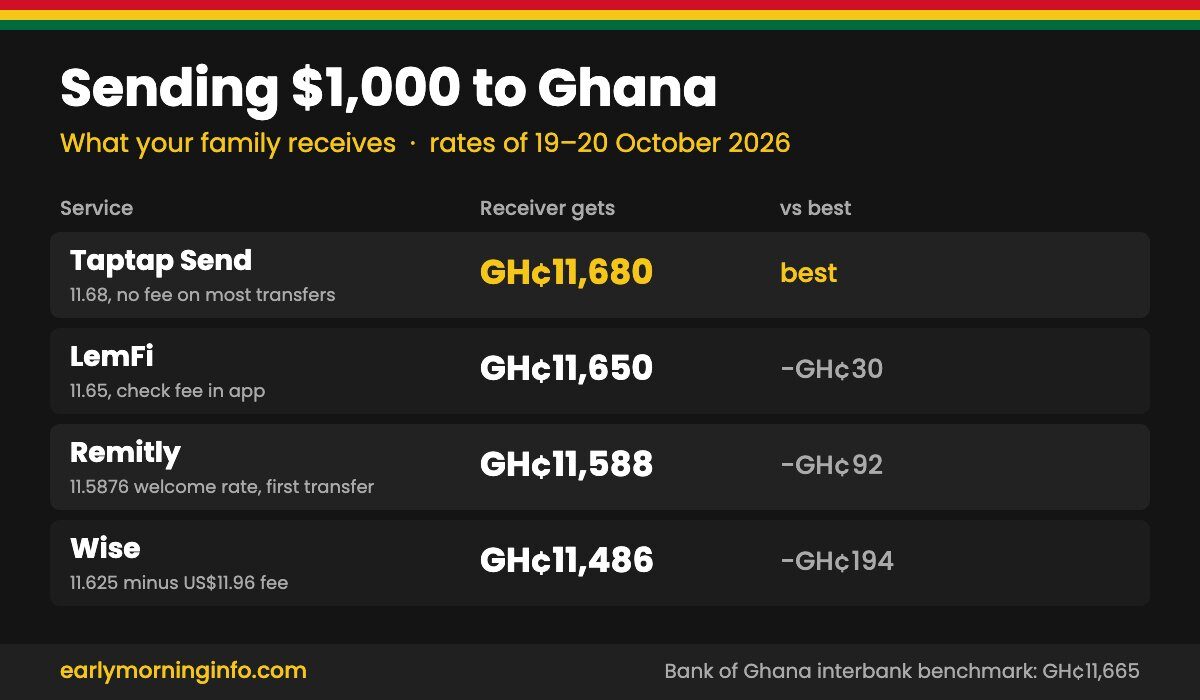
On October 19, Taptap Send was paying GH¢11.68 to the dollar and LemFi GH¢11.65, both right on top of the Bank of Ghana interbank rate of GH¢11.67. Those two gave the most cedis for a US$1,000 transfer of the services we checked.
Rates change every day. Always compare the cedi amount the receiver gets, not the fee.
What US$1,000 gets your family this week
| Service | Rate (GH¢ per $1) | Transfer fee | Receiver gets |
|---|---|---|---|
| Taptap Send | 11.68 (Oct 19) | Advertises no fees on most transfers | GH¢11,680 |
| LemFi | 11.65 (Oct 19) | Check in the app before you send | up to GH¢11,650 |
| Wise | 11.625 (Oct 20) | US$11.96 to US$19.05 depending on how you pay | GH¢11,404 to GH¢11,486 |
| Remitly | 11.5876 (Oct 20, new-customer “welcome rate”) | None shown | GH¢11,588 on a first transfer |
| Western Union | Not shown on its website | US$0 on the first online transfer | Get a quote first |
| Bank of Ghana interbank (benchmark) | 11.665 mid | — | GH¢11,665 |
Taptap Send and LemFi rates as reported in the Modern Ghana forex market report of October 19, 2026. Wise and Remitly rates as shown on their US websites on October 20, 2026; Wise fees are its own figures for a US$1,000 transfer. Receiver amounts are our arithmetic from those figures.
Look at Wise closely, because it shows why the fee is not the whole story. Wise is honest about its fee and gives a rate very close to the interbank rate, but once you take out US$12 to US$19 on a thousand-dollar transfer, your family ends up with about GH¢200 less than through Taptap Send. Remitly’s welcome rate, which applies only to a new customer’s first transfer, is about 9 pesewas a dollar below Taptap Send, which comes to roughly GH¢90 on the same thousand dollars.
The rate is where they make their money
Almost every app now shouts “zero fees”. That does not mean the transfer is free. The company earns its money by giving you fewer cedis per dollar than it gets for those dollars itself, and that margin is invisible unless you compare. Western Union says as much in the fine print on its own website: it makes money from currency exchange as well as from fees.
So the only fair test is the one in the table above. Put the same amount into two or three apps on the same morning, and look at the number on the screen that says how many cedis will land. Whichever is highest wins, whatever the app calls its fee. Do it every time, because the leader changes from week to week.
Mobile money, bank or cash pickup?
For most families, mobile money is the best way to receive. It lands in minutes on MTN MoMo, Telecel Cash or AT Money, the receiver does not need to travel anywhere, and every major app supports it. Remember that the receiver pays the usual MoMo charge to cash out at an agent, so for large amounts a bank account works out better.
Bank deposit is the right choice for school fees, rent, building money and anything large. It takes longer, from minutes to a working day depending on the app and the bank, but there is a clean record of where the money went, which matters if you are sending money for a project you cannot supervise yourself.
Cash pickup, mainly through Western Union, MoneyGram and Remitly’s partners, is useful for an elderly parent or a relative in a village without a MoMo agent nearby, but it is usually the most expensive route once the rate is counted.
Travelling home with dollars? The bureau may beat the apps
Here is something many people in the diaspora do not realise. On October 19, the forex bureaus in Accra were buying the dollar at GH¢11.90, according to the daily market report, which is more than any of the apps were paying. So if you are coming home with clean US$100 notes in your pocket, changing them at a licensed bureau gave you about GH¢220 more per thousand dollars than the best app that day.
That only works if you change at a licensed bureau, not with the boys on the street, if your notes are new and unmarked, and if you are comfortable carrying cash through the airport. Carrying more than US$10,000 out of the United States must be declared to US Customs. For regular monthly support to your people, the apps are still the safer and simpler choice.
How to protect yourself
Use only well-known services, and check that the app is licensed as a money transmitter in the state you are sending from; the serious ones list their licences on their websites. Send only to people you know. Never send money to someone you have met online who says they need it to clear a parcel at the port, pay a customs officer or release a “gold consignment”; that story has been running out of Ghana for twenty years and it has not got any more true. Double-check the MoMo number and the name the app shows before you confirm, because a payment to the wrong wallet is very hard to get back.
What is the cheapest way to send money to Ghana from the US?
On October 19, 2026, Taptap Send and LemFi were paying the most cedis per dollar among the services we checked, both within a few pesewas of the Bank of Ghana interbank rate. Check them against each other on the day you send, because the order changes.
How long does it take for money to reach Ghana?
Mobile money transfers through the main apps usually arrive within minutes. Bank deposits can take from a few minutes to a working day, and Wise says most of its transfers arrive in under a day.
Can I send dollars to Ghana and have them received in dollars?
Mobile money wallets in Ghana hold cedis, so anything sent to MoMo is converted. Some banks and services can pay into a dollar account in Ghana; ask the receiving bank before you send, and compare the rate you would get against converting at the start.
What is today’s dollar to cedi rate?
We keep the Bank of Ghana rate, the bureau rate and the app rates on our dollar to cedi rate today page, with a converter that updates itself daily.
Sources: Modern Ghana forex market report, October 19, 2026 (Bank of Ghana interbank, forex bureau, LemFi and Taptap Send rates); Wise, Remitly and Western Union US websites, October 20, 2026; Taptap Send website. Rates and fees change daily; this page is for information only. Last updated Tuesday, October 20, 2026.