 By
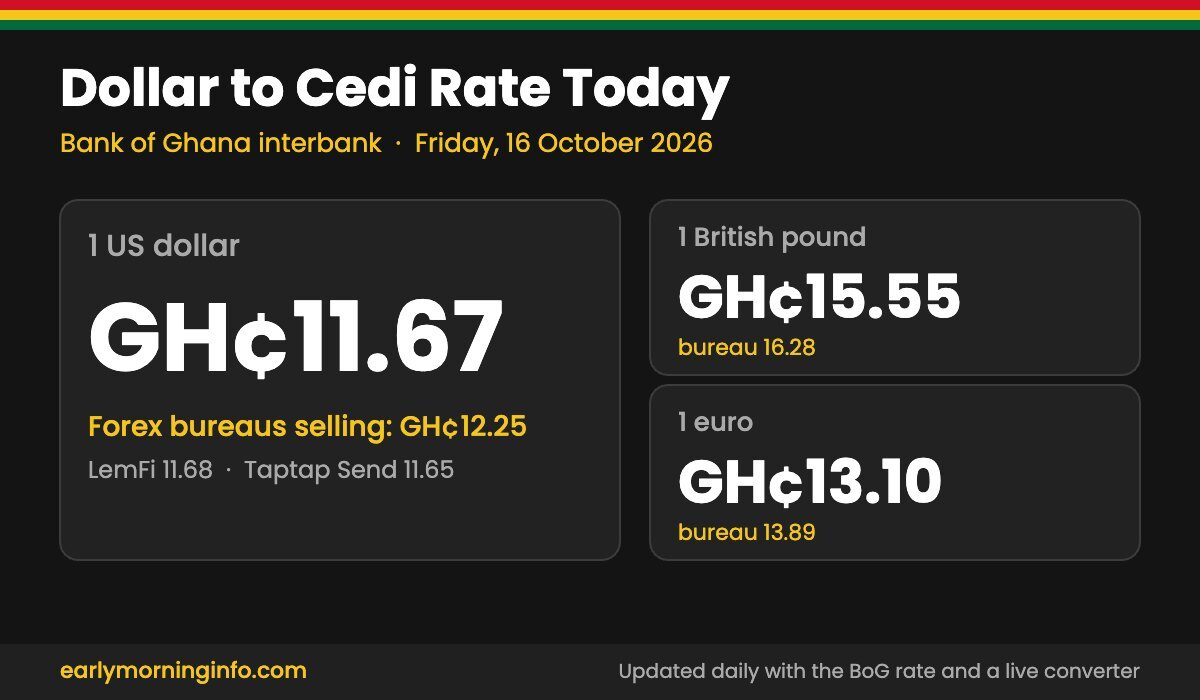
The cedi closed last week at GH¢11.67 to the dollar on the Bank of Ghana’s interbank market, while forex bureaus in Accra were selling the dollar at GH¢12.25, according to the central bank’s published rates and the Friday, October 16, 2026 market report. The pound went for GH¢15.55 on the interbank market and GH¢16.28 at the bureaus, and the euro for GH¢13.10 and GH¢13.89 respectively.
Dollar to cedi right now
1 USD = GH¢11.67
Bank of Ghana interbank mid rate, Friday, October 16, 2026. The live mid-market rate will load here.
This page is updated with every Bank of Ghana rate release and the weekly market round-up. The box above and the converter below also pull the live international mid-market rate once a day on their own, so you are never looking at a dead number.
Dollar, Pound and Euro to Cedi Rates Today
| Currency | BoG buying | BoG selling | Forex bureau buying | Forex bureau selling |
|---|---|---|---|---|
| US dollar (USD) | 11.6592 | 11.6708 | 11.90 | 12.25 |
| British pound (GBP) | 15.5370 | 15.5537 | 15.37 | 16.28 |
| Euro (EUR) | 13.0904 | 13.1023 | 13.07 | 13.89 |
Bank of Ghana interbank rates as published for Friday, October 16, 2026. Forex bureau rates are the Accra market rates reported the same day. The BoG publishes its rate at the close of each working day.
For those sending money home, the transfer apps were paying close to the interbank rate on Friday: LemFi was giving GH¢11.68 to the dollar and GH¢15.36 to the pound, while Taptap Send was at GH¢11.65 and GH¢15.47. Paying for Netflix, Spotify or Apple Music with a Ghanaian Visa or Mastercard cost between GH¢12.55 and GH¢12.57 to the dollar, which is roughly what the banks apply to any card payment in foreign currency.
Currency converter: dollars, pounds, euros and naira to cedis
100 USD = GH¢1,166.50
1 USD = GH¢11.6650 (Bank of Ghana mid rate, October 16, 2026)
Bureau and Bank of Ghana rates cover the dollar, pound and euro; other currencies use the live rate. Live mid-market rates by ExchangeRate-API. Illustration only; the rate you get depends on where you change the money.
How much is 1, 50, 100, 500 and 1,000 dollars in Ghana cedis?
The table below uses the Bank of Ghana mid rate of GH¢11.665 to the dollar. At a forex bureau in Accra you would pay roughly 5% more cedis for the same dollars, and get slightly fewer cedis when you sell.
| US dollars | Ghana cedis | US dollars | Ghana cedis |
|---|---|---|---|
| $1 | GH¢11.67 | $500 | GH¢5,832.50 |
| $5 | GH¢58.33 | $600 | GH¢6,999.00 |
| $10 | GH¢116.65 | $700 | GH¢8,165.50 |
| $20 | GH¢233.30 | $800 | GH¢9,332.00 |
| $25 | GH¢291.63 | $1,000 | GH¢11,665.00 |
| $30 | GH¢349.95 | $1,500 | GH¢17,497.50 |
| $40 | GH¢466.60 | $2,000 | GH¢23,330.00 |
| $50 | GH¢583.25 | $3,000 | GH¢34,995.00 |
| $80 | GH¢933.20 | $4,000 | GH¢46,660.00 |
| $100 | GH¢1,166.50 | $5,000 | GH¢58,325.00 |
| $150 | GH¢1,749.75 | $7,000 | GH¢81,655.00 |
| $200 | GH¢2,333.00 | $10,000 | GH¢116,650.00 |
| $250 | GH¢2,916.25 | $20,000 | GH¢233,300.00 |
| $300 | GH¢3,499.50 | $50,000 | GH¢583,250.00 |
| $400 | GH¢4,666.00 | $1,000,000 | GH¢11,665,000.00 |
Pounds to Ghana cedis
| British pounds | Ghana cedis | British pounds | Ghana cedis |
|---|---|---|---|
| £1 | GH¢15.55 | £250 | GH¢3,886.35 |
| £5 | GH¢77.73 | £500 | GH¢7,772.70 |
| £10 | GH¢155.45 | £1,000 | GH¢15,545.40 |
| £50 | GH¢777.27 | £2,000 | GH¢31,090.80 |
| £100 | GH¢1,554.54 | £5,000 | GH¢77,727.00 |
Euros and naira to Ghana cedis
| Euros | Ghana cedis | Nigerian naira | Ghana cedis |
|---|---|---|---|
| €1 | GH¢13.10 | ₦10,000 | GH¢87.52 |
| €100 | GH¢1,309.64 | ₦50,000 | GH¢437.60 |
| €150 | GH¢1,964.46 | ₦100,000 | GH¢875.21 |
| €200 | GH¢2,619.28 | ₦500,000 | GH¢4,376.04 |
| €300 | GH¢3,928.92 | ₦1,000,000 | GH¢8,752.08 |
| €1,000 | GH¢13,096.40 | ₦5,000,000 | GH¢43,760.42 |
Euro figures use the Bank of Ghana mid rate. Naira figures use the international mid-market cross rate (about GH¢8.75 per ₦1,000), which is not the rate you will get at a bureau in Accra or Lagos.
Why the cedi is where it is
Anyone who has been following the rate knows the story of the last two years. In the first half of 2025, the cedi did what nobody expected and appreciated by 42.6% against the dollar, 30.3% against the pound and 25.6% against the euro, which the central bank credited to its gold purchase programme, the IMF-backed reforms and a weaker dollar worldwide. That took the rate from the GH¢15 region down to below GH¢11.
In 2026 the direction has been the other way, but gently. The Bank of Ghana’s Monetary Policy Report put the cedi’s depreciation at 7.9% against the dollar in the first half of the year, 6.5% against the pound and 5.3% against the euro. The central bank said the currency came under intense pressure in May before recovering, and that it was less volatile in the first 140 trading days of 2026 than in any of the previous years. Its outlook is for the cedi to remain relatively stable in the medium term as remittances continue to flow in and demand for dollars from the banks eases.
Which rate will you actually get?
This is where most people get confused, so let us break it down. The Bank of Ghana interbank rate is what the banks charge each other. It is the official reference rate, and it is the one you hear on the news, but you cannot walk into a bank and demand it. The forex bureau rate is what you get on the street in Accra, Kumasi or Tema, and it is always higher when you are buying dollars and lower when you are selling. On Friday the gap between the two was about 60 pesewas on the dollar. The bank counter rate sits somewhere in between for customers with accounts, and the card rate your bank uses when you pay for Netflix or shop on Amazon is the highest of all, at about GH¢12.55 to the dollar.
The transfer app rate is the one that matters for the diaspora. LemFi, Taptap Send, Sendwave, Remitly and the rest make their money on the rate rather than the fee, so a “zero fee” transfer at GH¢11.40 is worse than a GH¢5 fee at GH¢11.68. Always compare the cedi amount your family will actually receive, not the fee.
How to get the best dollar to cedi rate
If you are changing cash in Ghana, the licensed bureaus around Osu, Kokomlemle and the Kwame Nkrumah Circle area generally quote better than the airport, and new, clean $100 bills attract a slightly better rate than small or worn notes. If you are sending money from abroad, check two or three apps on the day, because the rates move daily and the best one changes week to week. If you are receiving a salary or payment in dollars, ask your bank for the rate it will apply before the money lands; many banks let you hold the dollars in a foreign currency account and change them when the rate suits you. And never change money with the “black market” boys who approach you on the street; the Bank of Ghana and the police have been cracking down on unlicensed operators, and the fake notes are real.
How much is 1 dollar in Ghana cedis today?
One US dollar was GH¢11.67 at the Bank of Ghana’s interbank rate on Friday, October 16, 2026, and GH¢12.25 at the forex bureaus. The live mid-market figure is in the box at the top of this page.
How much is 100 dollars in Ghana cedis?
About GH¢1,166.50 at the Bank of Ghana rate, or GH¢1,225 at the bureau selling rate. The full table above gives every common amount.
What is the pound to cedi rate today?
GH¢15.55 on the interbank market and GH¢16.28 at the bureaus, as at Friday, October 16, 2026. LemFi and Taptap Send were paying GH¢15.36 and GH¢15.47 respectively.
Why is the bureau rate higher than the Bank of Ghana rate?
Because the bureau is a retail business that has to source its dollars, pay its staff and make a margin, and because demand for physical dollars from importers and travellers is always ahead of supply. The Bank of Ghana rate is a wholesale rate between banks. When the gap between the two widens sharply, it is usually a sign of pressure building on the cedi.
Where does the Bank of Ghana publish its rate?
On its website, under Treasury and the Markets, as daily interbank FX rates, with buying, selling and mid rates for the dollar, pound, euro and other major currencies. The figures on this page are taken from there and from the daily market reports.
Sources: Bank of Ghana daily interbank FX rates (October 16, 2026); Modern Ghana forex market report of October 16, 2026 (bureau, Cedirates.com, LemFi and Taptap Send rates); Bank of Ghana Monetary Policy Report as reported by the Ghana News Agency, August 30, 2026; live mid-market rates by ExchangeRate-API. This page is for information only. Last updated Monday, October 19, 2026.