 By
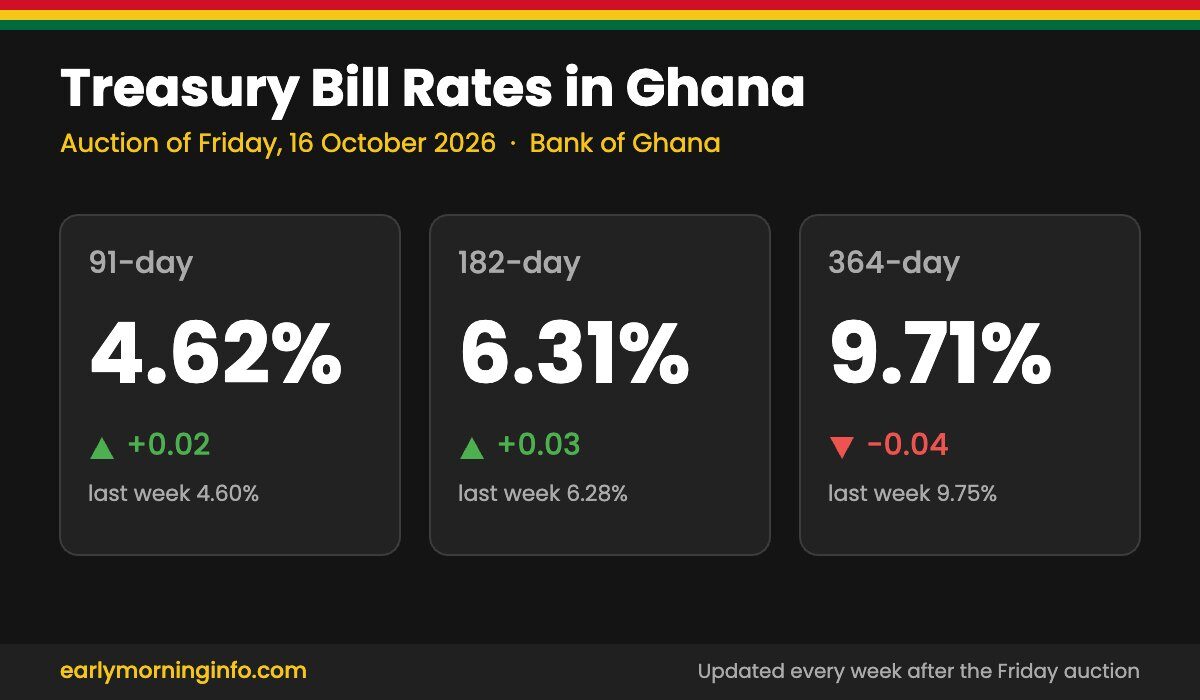
Interest rates on government’s short-term treasury bills inched up marginally at last Friday’s auction, even as the one-year bill recorded a slight dip, results of the auction held on Friday, October 16, 2026 show.
The 91-day bill is now going for 4.62%, up from 4.60% the previous week, while the 182-day bill moved up to 6.31% from 6.28%. The 364-day bill, however, eased to 9.71% from 9.75%.
This page is updated every Monday after the Bank of Ghana’s weekly auction, so what you see below is the current rate. Save it and check back each week.
Treasury Bill Rates in Ghana as at October 16, 2026
| Bill | This week | Last week | Change |
|---|---|---|---|
| 91-day | 4.62% | 4.60% | ▲ +0.02 |
| 182-day | 6.31% | 6.28% | ▲ +0.03 |
| 364-day | 9.71% | 9.75% | ▼ −0.04 |
Figures are the interest rates (yields) from the Bank of Ghana auction. Change is in percentage points.
Government misses target by GH¢1.53 billion
Government went to the market for GH¢5.01 billion but managed to raise only GH¢3.48 billion, leaving a shortfall of about GH¢1.53 billion. In other words, the auction was undersubscribed by close to 31%.
Investors tendered GH¢2.94 billion for the 91-day bill, out of which GH¢2.20 billion was accepted. The 182-day bill attracted bids of GH¢1.11 billion, with GH¢692 million accepted, while GH¢1.12 billion was tendered for the 364-day bill and GH¢587 million taken.
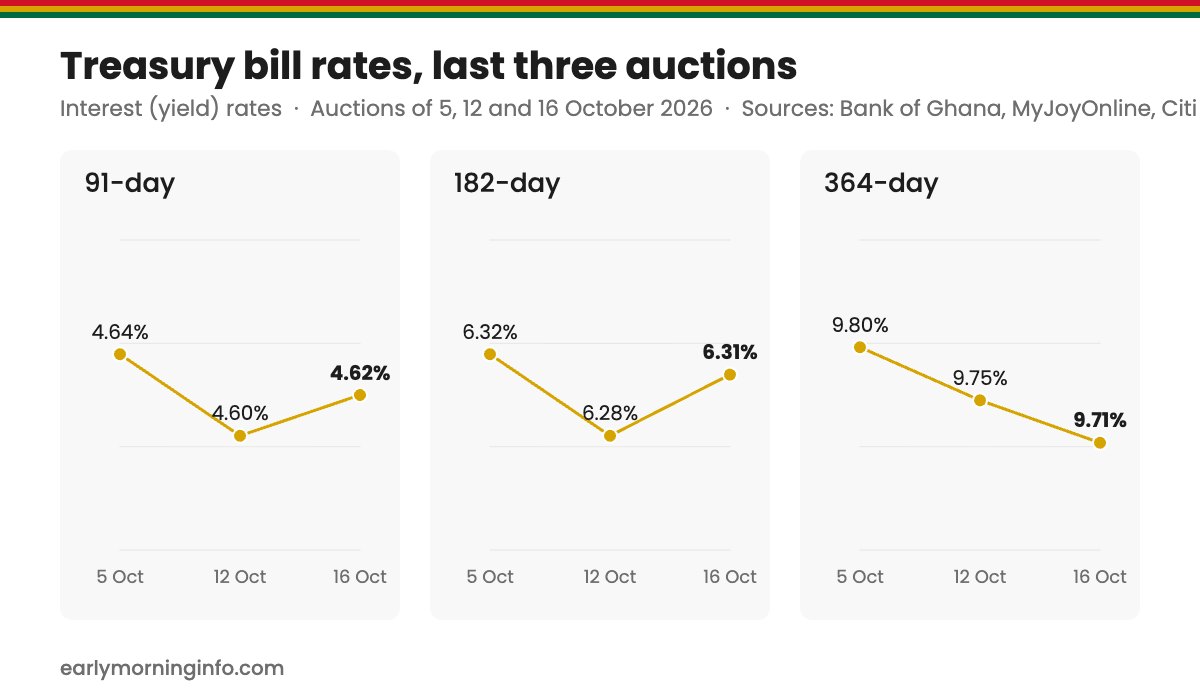
The undersubscription is a turnaround from the previous week, when government recorded an oversubscription of about 53%, accepting GH¢4.41 billion against a target of GH¢2.87 billion. It would be recalled that at that auction, the 91-day rate dropped to 4.60% from 4.64%, the 182-day to 6.28% from 6.32%, and the 364-day to 9.75% from 9.80%.
The marginal uptick in the short-term rates this week is the first in several weeks, after yields fell steadily through the greater part of 2026 on the back of easing inflation and the Bank of Ghana’s policy rate cuts.
Treasury bill calculator: how much will your money earn?
Enter the amount you intend to invest and see what you stand to earn at this week’s rates.
| Bill | Rate | Interest | Total at maturity |
|---|---|---|---|
| 91-day | 4.62% | — | — |
| 182-day | 6.31% | — | — |
| 364-day | 9.71% | — | — |
Worked as simple interest: amount × rate × days ÷ 365. The exact figure your bank pays will depend on the auction price and any charges.
To put it in perspective, GH¢10,000 locked in the 91-day bill at this week’s rate will fetch you roughly GH¢115 in interest. The same amount in the 182-day bill gives you about GH¢315, and the 364-day bill about GH¢968. Compare that with the days when the 91-day bill alone was paying over 30%, and you understand why a lot of people have been asking whether T-bills are still worth it. The short answer is yes, if your priority is safety, but you must shop around.
Discount rate vs interest rate: what the two figures on the BoG website mean
Anyone who has visited the Bank of Ghana website would have noticed that two different rates are quoted for each bill, and this confuses a lot of people.
The discount rate is the amount taken off the face value when you buy. In simple terms, you pay less than GH¢100 for a GH¢100 bill today and collect the full GH¢100 when it matures. The interest rate, on the other hand, is what you actually earn on the money you put down, and it is always slightly higher than the discount rate. When you are comparing with a fixed deposit at your bank, the interest rate is the one to use.
For the records, these are the Bank of Ghana figures for the issue of October 12, 2026 (Tender 2028):
| Bill | Discount rate | Interest rate |
|---|---|---|
| 91-day | 4.5518% | 4.6042% |
| 182-day | 6.0880% | 6.2791% |
| 364-day | 8.8857% | 9.7523% |
Which bank gives the highest treasury bill rate in Ghana?
This is probably the most common question on the matter, and the answer may surprise you: no bank gives a better T-bill rate than the other. Treasury bills are issued by the Government of Ghana through the Bank of Ghana, and whether you buy from GCB Bank, Fidelity Bank, Stanbic, Absa, CalBank, Ecobank or your local rural bank, you are buying the same bill at the same auction rate.
What differs from bank to bank is the minimum amount they will take, the charges, how fast they process you, and whether you can do everything from your phone without joining a queue at the branch. Ask about charges before you commit. At today’s rates, a fee of even 1% wipes out a big chunk of what the 91-day bill will pay you.
Treasury bill or fixed deposit: which one pays better?
When you buy a treasury bill, you are lending to the Government of Ghana, and that makes it the safest cedi investment there is. A fixed deposit, on the other hand, is a loan to a bank, and the bank decides what to pay you. Some banks pay above the T-bill rate when they are hungry for deposits; others pay below.
So do not take anybody’s word for it. Walk into the bank, ask for their fixed deposit rate for 91, 182 or 364 days, place it side by side with the T-bill interest rate on this page, and ask about penalties if you need your money before time. The one that pays better changes from month to month.
How to buy treasury bills in Ghana
You can buy through any commercial bank, either at the branch or on the bank’s mobile app, through a licensed investment firm or broker, or through the mobile money and investment apps that now sell government securities. You will need your Ghana Card and the money sitting in your bank account or MoMo wallet. Tell them which tenor you want, 91, 182 or 364 days, and whether you want it to roll over automatically when it matures or you want your money paid back to you. If you are in the diaspora and planning to come home, our guide on moving to Ghana from the US covers the Ghana Card and bank account you will need before you can buy.
When do treasury bill rates change?
Every week. The Bank of Ghana holds the auction on Fridays and the bills are issued the following Monday. This page is updated after each auction.
Why have T-bill rates fallen so much?
Rates follow inflation, the Bank of Ghana’s policy rate and, to a lesser degree, the cedi’s movement against the dollar. As inflation came down sharply in 2025 and 2026, government no longer had to pay through the nose to borrow, and T-bill rates fell from the 20% to 30% range of the crisis years to single digits on the short-term bills. Whether they will go any lower depends on where inflation goes from here.
Where is the official source?
The Bank of Ghana publishes the results of every auction on its Treasury Bill Rates page. The figures on this page are taken from those results and from the weekly auction reports.
Also on Early Morning Info
- Dollar to cedi rate today: Bank of Ghana, bureau and transfer rates
- Moving to Ghana from the US in 2026: visas, Right of Abode, rent and real costs
- More guides for living in Ghana
Sources: Bank of Ghana treasury bill rates (issue of October 12, 2026, Tender 2028); results of the auction of October 16, 2026 as reported by Citi Newsroom; the previous week’s auction as reported by MyJoyOnline. This page is for information only and is not financial advice. Last updated Monday, October 19, 2026.