 By
Every December, Kotoka International Airport fills up with Ghanaians coming home for the holidays and African Americans coming to see the land for the first time. A good number of them go back to the States with one question on their mind: what would it actually take to move here for good?
This guide answers that question with the figures as they stand today, not the rosy picture you see on Instagram. We have gone through the Ghana Immigration Service fee schedule, the Embassy in Washington, the National Identification Authority’s latest fees and the current rent and exchange rates to put together what a move from the United States to Ghana really involves in 2026. Where a figure can change, we have dated it and told you where to check.
First things first: your right to live in Ghana
A tourist visa gets you into the country. It does not let you stay. Which route you take depends on who you are, and the difference in cost runs into thousands of dollars, so start here.
If you are a Ghanaian with an American passport
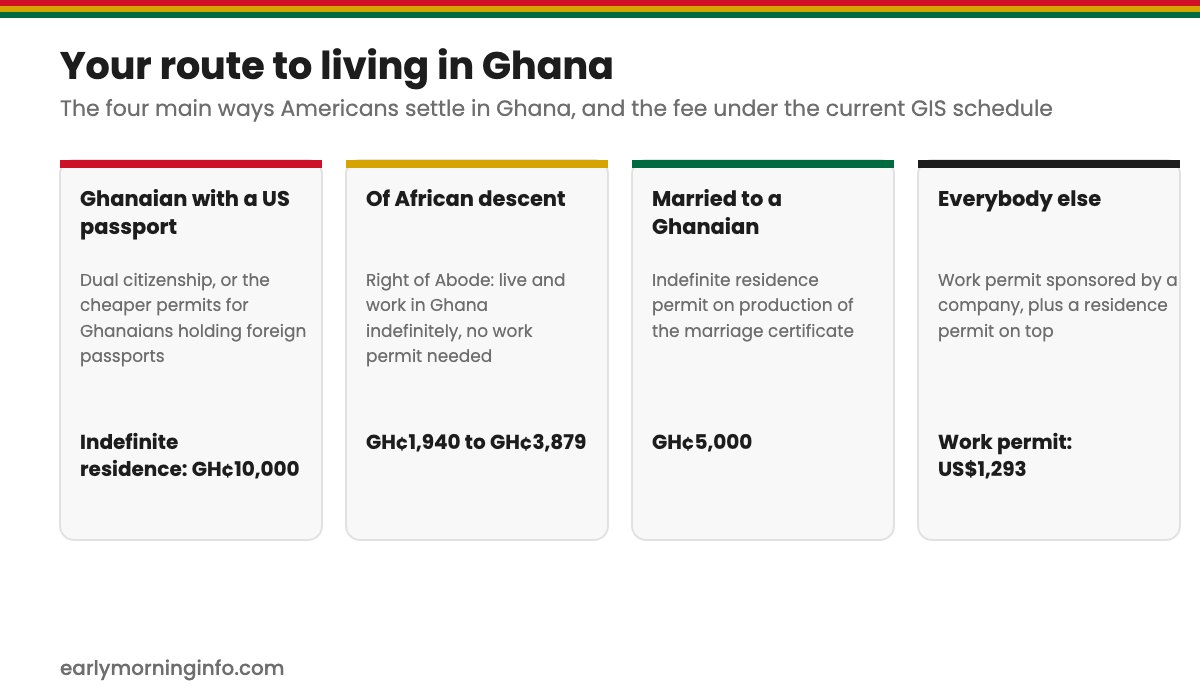
You are in the best position. Ghana allows dual citizenship, so if you were born Ghanaian or have a Ghanaian parent, apply for a dual citizenship certificate through the Ministry of the Interior and register for your Ghana Card. With that, you need no visa and no permit; you simply come home. If you would rather not go through the dual citizenship process, the GIS fee schedule has a separate, cheaper column for “Ghanaians holding foreign passports”: an indefinite residence permit, for instance, is GH¢10,000 for you against US$18,000 for other nationals.
If you are of African descent (African American, Caribbean)
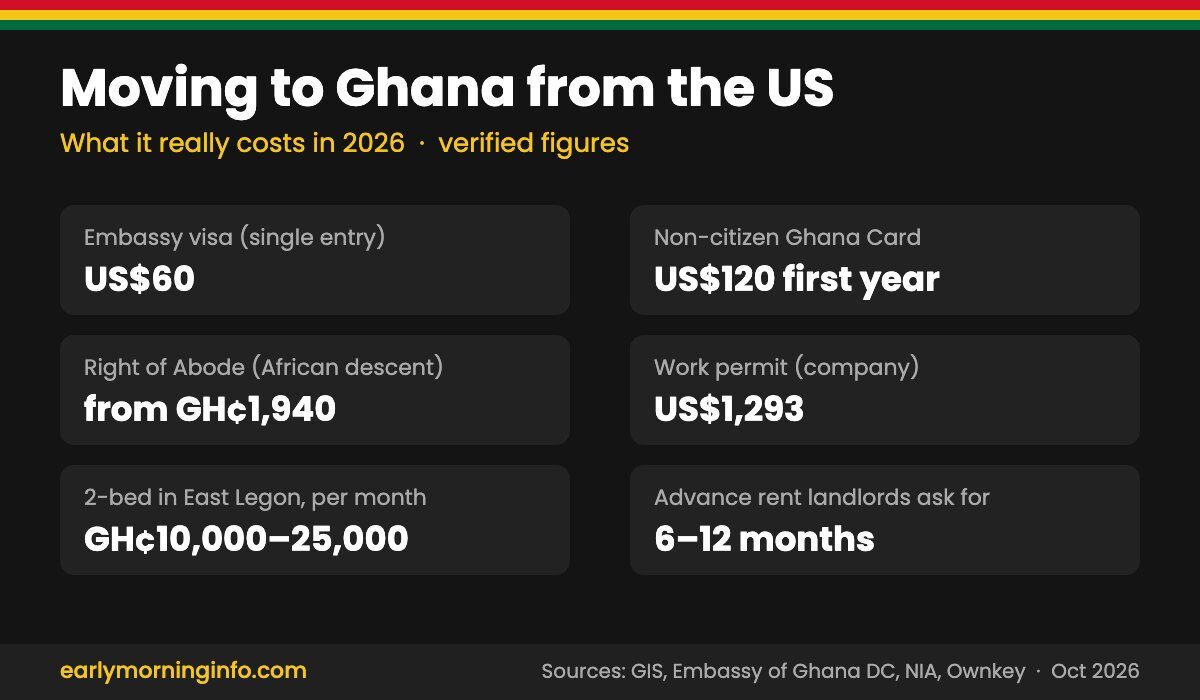
Ghana’s Immigration Act gives persons of African descent in the diaspora the Right of Abode, which lets you live and work in Ghana indefinitely without a work permit, and come and go freely. It is the route most of the Year of Return settlers have used. The GIS fee schedule lists it at GH¢1,940 to GH¢3,879 depending on your category, and you apply through the Ghana Immigration Service headquarters in Accra. You will need a police report from the US, proof of your means of support and the usual passport photographs, and it takes months rather than weeks, so apply early.
If you are married to a Ghanaian
The spouse of a Ghanaian citizen qualifies for an indefinite residence permit at GH¢5,000, according to the GIS schedule, on production of the marriage certificate and your partner’s proof of citizenship.
If none of the above applies to you
Then you are looking at a residence permit backed by either a job, a business or retirement funds. A work permit sponsored by a company costs US$1,293 for non-ECOWAS nationals under the current GIS schedule, and the residence permit is a separate application on top of it. If you intend to run a business, registering with the Ghana Investment Promotion Centre gives you an automatic quota of work permits at US$500 each. These fees took effect on May 15, 2025 and are quoted by GIS at an exchange rate of GH¢11 to the dollar, so expect the cedi amounts to be adjusted.
The visa to get you in
For the trip itself, the Embassy of Ghana in Washington lists a single-entry visa at US$60 and a multiple-entry visa at US$100 for standard processing of 15 to 20 business days, with rush service in seven business days at US$100 and US$200 respectively. Applications are online only, after which you post your passport to the Embassy. You will need a yellow fever certificate, a letter of invitation from a host in Ghana (or your hotel booking), a return ticket and proof of funds.
Ghana also launched its first e-visa portal, evisa.immigration.gov.gh, on May 25, 2026. It is faster, but the fees reported for it are far higher than the Embassy’s, with a single-entry e-visa quoted at US$260. Compare the two before you pay, and use only the official portal; copycat websites are already appearing. We go through both routes step by step, with the documents and the pitfalls, in our guide to the Ghana visa for US citizens.
Non-citizen Ghana Card
Any foreigner living in Ghana for more than 90 days is expected to register with the NIA for a non-citizen Ghana Card. You will not open a bank account, register a SIM card or sign a proper tenancy without it. Under the fees that took effect on February 2, 2026, first-time registration is the cedi equivalent of US$120, annual renewal US$78, and a multi-year renewal US$75 a year.
Money: what Ghana costs in dollars
As at October 16, 2026, the dollar was selling at GH¢11.66 on the Bank of Ghana interbank market and around GH¢12.25 at the forex bureaus, according to the daily market reports; we keep the dollar to cedi rate updated on its own page, with a converter. After the volatility of 2022 and 2023, the cedi has been relatively stable, but the gap between the bank rate and the bureau rate is real money when you are moving your savings, so send through a regulated transfer service rather than carrying cash. The transfer apps were quoting around GH¢11.65 to GH¢11.68 to the dollar on the same day. Once your money is here, the safest place to park it is government paper; see our weekly page on treasury bill rates in Ghana for what the 91, 182 and 364-day bills are paying right now.
Accra is not cheap for the lifestyle most Americans expect, and this is where people get the shock. The compounds you see on YouTube in Cantonments and Airport Residential are priced for diplomats and oil executives. Here is what rent looks like, from Ownkey’s first-quarter 2026 listing data, per month and unfurnished:
| Area | 1-bed | 2-bed | 3-bed |
|---|---|---|---|
| Cantonments | GH¢8,000–20,000 | GH¢18,000–40,000 | GH¢30,000–80,000 (≈$2,600–7,000) |
| Airport Residential | GH¢8,400–24,000 | GH¢18,000–42,000 | GH¢30,000–90,000+ |
| Labone / North Labone | GH¢7,000–16,000 | GH¢14,000–30,000 | GH¢22,000–55,000 |
| East Legon | GH¢5,000–14,000 | GH¢10,000–25,000 | GH¢15,000–35,000 (≈$1,300–3,000) |
| Osu | GH¢4,000–12,000 | GH¢8,000–20,000 | GH¢13,000–30,000 |
| Spintex | GH¢3,000–8,000 | GH¢5,500–14,000 | GH¢8,000–18,000 (≈$700–1,565) |
| Tema (Community 25) | GH¢2,000–5,500 | GH¢4,000–9,500 | GH¢6,000–14,000 |
| Adenta | GH¢1,000–4,000 | GH¢3,000–7,000 | GH¢5,000–10,000 (≈$435–870) |
| Kasoa | GH¢800–2,500 | GH¢1,500–4,500 | GH¢3,000–6,500 |
Furnished apartments go for 20 to 30 percent more. Dollar figures at roughly GH¢11.5 to the dollar.
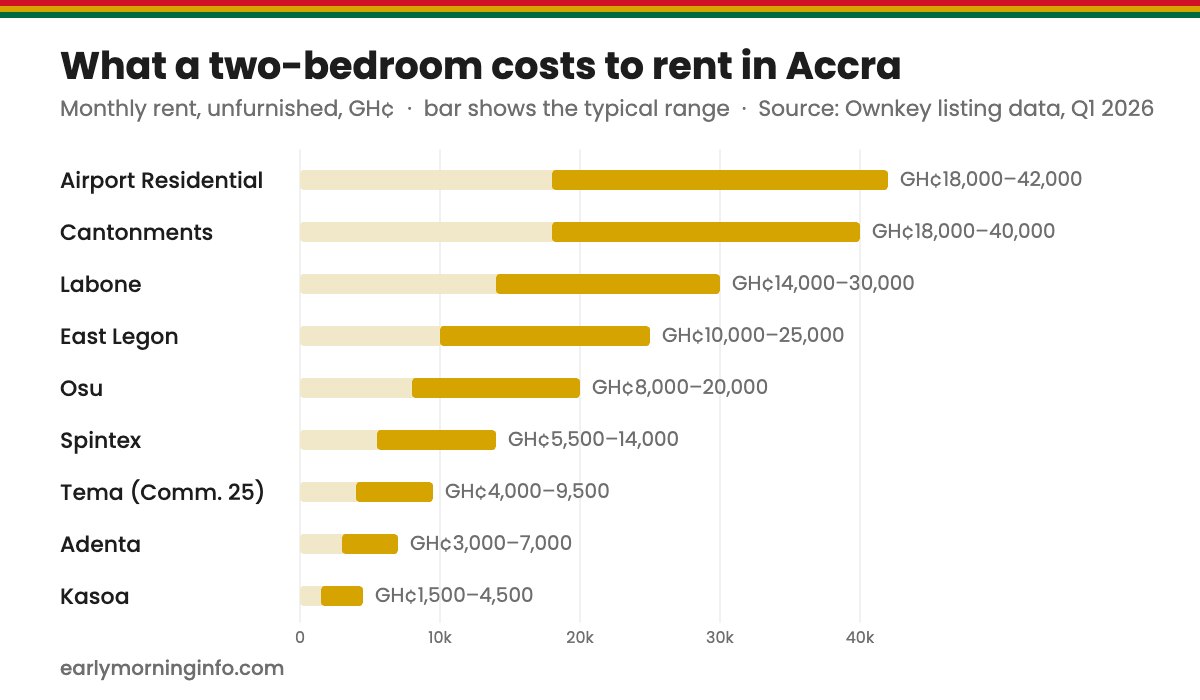
Now the part nobody tells you until you are standing in the living room with the landlord: rent in Ghana is paid in advance, and in the areas foreigners prefer, landlords routinely ask for six months to a year upfront, sometimes two. On a GH¢20,000-a-month flat in East Legon, that is GH¢240,000, more than US$20,000, before you have bought a bed. Budget for it, never hand over advance rent without a written tenancy agreement, and have a lawyer check that the person collecting the money actually owns the property.
Outside of rent, the big line items are a car and fuel, imported groceries, international school fees if you have children, and private health insurance. Live like a Ghanaian, with local food, trotro or ride-hailing instead of your own car, and a flat in Spintex or Tema, and your monthly spend falls sharply. Imported goods, from cereal to car parts, are where the dollar disappears fastest.
Shipping your things, and whether to bring the car
Shipping a car from the US East Coast to Tema costs in the region of US$1,650 for the ocean leg from New York, taking about 27 days at sea and seven to eight weeks door to door, according to freight forwarders’ 2026 pricing. From California it is closer to US$1,900 and 10 to 11 weeks. That is the easy part. The duties are where it bites.
Ghana measures a used car’s age from its model year and penalises anything over 10 years old. A 2016 model is the oldest you can land in 2026 without an over-age penalty; freight forwarders report penalties of about 5 percent of the car’s value for 10 to 12 years, 20 percent for 12 to 15 years and 50 percent for 15 to 25 years, on top of the normal import duty, VAT and levies. Right-hand-drive vehicles are prohibited outright, and you need a G-CAP pre-shipment inspection certificate before the car leaves America. Get a written quote from a licensed clearing agent at Tema before you ship anything, and compare it with the price of the same car on the Ghanaian market. Very often, buying in Ghana wins.
Household goods go in a 20-foot or 40-foot container, and the same advice applies: a licensed clearing agent, a detailed manifest of everything inside, and a realistic expectation that clearing at the port takes time and patience.
Health care
You will need a yellow fever vaccination certificate to enter Ghana at all. Once here, the National Health Insurance Scheme is open to residents, but most people moving from the US take private health insurance, either a Ghanaian plan or an international policy that covers evacuation. Accra has good private hospitals and clinics; the regions have far fewer, so where you choose to live matters. Bring a supply of any regular medication and your prescriptions, and talk to your doctor about malaria prevention before you travel; malaria is a fact of life here and newcomers are the most vulnerable.
Taxes: Uncle Sam is coming with you
American citizens must file a US tax return every year no matter where in the world they live. The good news is the Foreign Earned Income Exclusion, which for the 2026 tax year lets you exclude up to US$132,900 of income earned abroad, and the Foreign Tax Credit for Ghanaian taxes paid. The bad news is that Ghana will also treat you as a tax resident once you spend 183 days or more in the country in a 12-month period, and will tax your Ghana-sourced income. Retirees drawing US pensions and Social Security need specific advice, because the treatment differs. Pay a cross-border tax professional for one proper consultation before you move; it is cheaper than the penalties.
Where to settle
Accra is where the jobs, the international schools, the hospitals and the diaspora community are, and that is why most people start there. Within Accra, Cantonments, Labone and Airport Residential are the premium, walkable, diplomatic neighbourhoods; East Legon is the diaspora favourite, with the restaurants and gyms to match; Osu is lively and central; Spintex and Tema are where you get a decent house for the price of a flat in East Legon, at the cost of the traffic into town. Kumasi gives you a big-city life at a fraction of Accra’s rents, and Cape Coast and the Central Region coast have become the choice of retirees and the heritage-tourism crowd who want the sea and the slower pace.
The everyday things that catch newcomers
Electricity is supplied by ECG and it is far more reliable than it was during the “dumsor” years, but outages still happen, so budget for an inverter or solar backup if you work from home. Water pressure in many areas is low or intermittent, which is why every house has a polytank. Mobile money is how Ghana pays for everything, from the plumber to the market woman; you will need your Ghana Card to register a SIM on MTN, Telecel or AT and to open a MoMo wallet. You can drive on your US licence for a short period and then convert it at the DVLA. And yes, you can live in Accra speaking only English, but learning greetings in Twi or Ga will open more doors than any amount of money. One more thing: football is the national conversation, so knowing when the Black Stars play next and where Hearts and Kotoko sit in the Premier League table will carry you through more trotro rides and barbershop debates than anything else.
The mistakes we see over and over
Paying for land without a search at the Lands Commission, and discovering that three other people have bought the same plot. Paying advance rent to an “agent” who has never met the landlord. Sending money to a relative to build a house and getting progress photographs of somebody else’s house. Assuming a Ghanaian salary will fund an American lifestyle. And going through “goro boys” at the passport office, DVLA or port instead of the official channels, which costs more and leaves you with documents you cannot rely on. None of this should put you off. It should put you on guard, and it should make you spend the money on a lawyer at the beginning rather than at the end.
How much money do I need to move to Ghana from the US?
Work it out from the rent figures above, because advance rent is the biggest single cost. A year upfront on a two-bedroom in East Legon alone comes to GH¢120,000 to GH¢300,000, roughly US$10,000 to US$26,000 at today’s rate. Add furniture and appliances, your permit and Ghana Card fees, health insurance, a used car or six months of ride-hailing, and a cushion for the surprises, and a comfortable first year in Accra runs comfortably into the tens of thousands of dollars. Choose Tema, Kasoa or Kumasi and you can do it for a fraction of that.
Can a US citizen live in Ghana permanently?
Yes. Through dual citizenship if you have Ghanaian roots, the Right of Abode if you are of African descent, an indefinite residence permit as the spouse of a Ghanaian, or renewable residence and work permits for everybody else.
Is Ghana safe for Americans?
Ghana is one of the most stable and peaceful countries in West Africa, and the crime that affects newcomers is overwhelmingly fraud and petty theft rather than violence. Use the same sense you would use in any big city, and be especially careful in property transactions.
Do I need to speak Twi?
No. English is the official language and you can do everything in it. But a few words of Twi will change how people receive you, and your bargaining position at the market.
Also on Early Morning Info
- Ghana visa for US citizens: fees, requirements, e-visa vs embassy
- Dollar to cedi rate today, with a live converter
- Treasury bill rates in Ghana today (updated weekly)
- Black Stars next match: Ghana vs Somalia
- Ghana Premier League table 2026/27
Sources: Ghana Immigration Service fees and charges (effective May 15, 2025); Embassy of Ghana, Washington DC visa requirements; Ghana News Agency report on NIA fees effective February 2, 2026; Ownkey Accra rent data, Q1 2026; Modern Ghana forex report, October 16, 2026; IRS 2026 inflation adjustments; freight forwarders’ 2026 Ghana vehicle import guidance. Figures are correct as at the date of publication and this guide is for information only. Last updated October 19, 2026.